You Can Read an 'Easy' Language on Day One, With Help
I speak no Spanish. Here is the first chapter of a Spanish novel as I read it on day one, word by word, and how a beginner can start by reading.
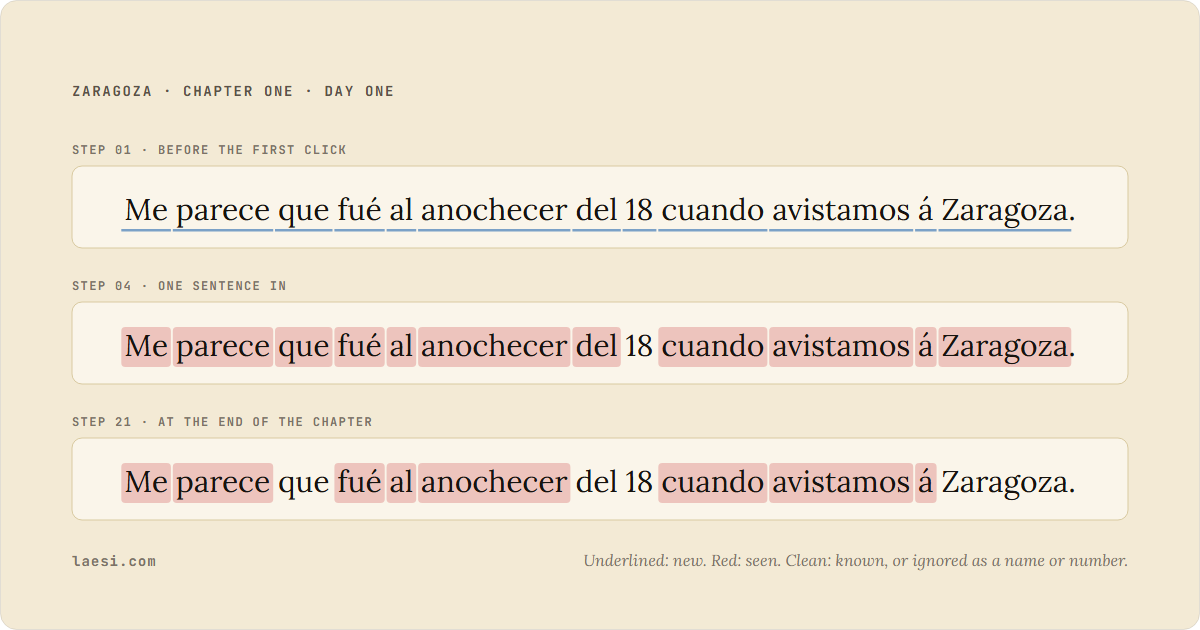
I speak no Spanish. At least not yet. This article is the start of a series on how even a complete beginner can begin learning by reading, in the right conditions. Now 'reading' in this case is probably not what you are used to. You can read in English. You see a sentence, and understand it. What I am going to do is intensively read, with a lot of help. So I am going to show that process here, instead of tell.
Now there are caveats to this, but if you can read this, you can definitely follow along.
The figure usually quoted from the research is that reading without help takes knowing about 98% of the words on the page. On day one I know almost none of them.
My advantages
Per the FSI estimates, Spanish is a Category I language for me: 30 weeks of full-time study, at 23 hours of class and 17 of self-study a week, or 1,200 hours. That is the "easy" in the title. However, this is not my first time learning a language. I know this process will work because I have done it before. The confidence in that knowledge is empowering. I know the process will be difficult, even if Spanish is comparatively easy as language learning goes, but I know roughly what to expect. Those estimates are for professional proficiency, speaking included. My goal is smaller. I know, despite the estimates, it will take me probably 100 to 200 hours to feel comfortable reading with minimal or no assistance, and if I read for 30 minutes a day, I can be at a place where reading independently may be possible in nine months.
I can do this, in part, because I speak several languages within the European Sprachbund, the area linguists call Standard Average European. While none are a Romance language, there is enough interchange that I am going to have natural advantages. I also speak English natively, and know there are a lot of cognates I am going to get for free and passively understand.
I also know how to find content in other languages to read and hear. I will over time help you do the same, but in 5 minutes, I was able to have a 70K word epub legally downloaded on my computer and also have an audiobook to go along with it.
In those five minutes I found and chose Zaragoza by Benito Pérez Galdós. I did seriously consider Don Quixote, but decided a text from the past 200 years would be a better starting point than one from the past 400. Normally, I would not have chosen this type of text. I would have chosen something I had familiarity with going in, be it Harry Potter or the subtitles from Encanto. However, I wanted something in the public domain so I can bring you along for the journey.
What is my why?
If I am about to spend up to 200 hours of my life learning to do something, the obvious question I should ask myself is, why? I have studied many Germanic and Nordic languages, and actively avoided Romance languages, so why the change? Well, my children go to a Spanish immersion daycare, and I would like to be able to support them as they get older. It is important to me that when they go to school, they do not simply forget and lose the language. Also, if they start having any secret conversations I would like to be able to understand them… If nothing else.
In Laesi, what does Zaragoza look like to me?
-
-
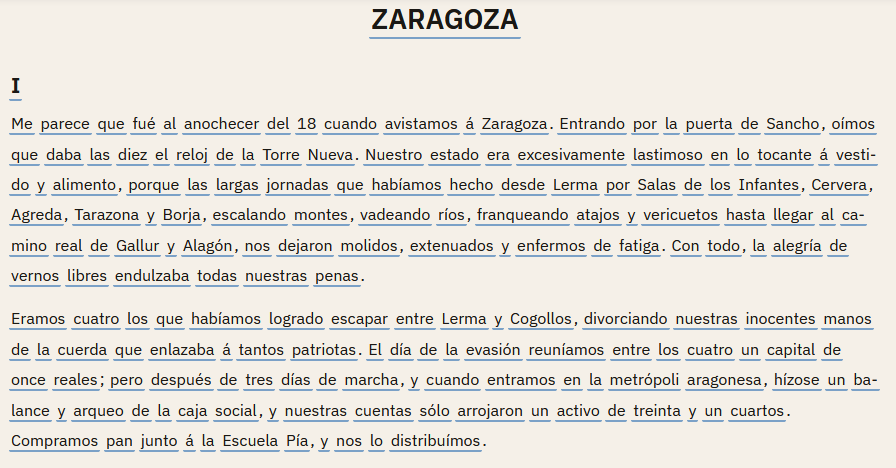
One note before the first click. This printing is from 1901 and spells a few small words the old way: á and fué are a and fue today.
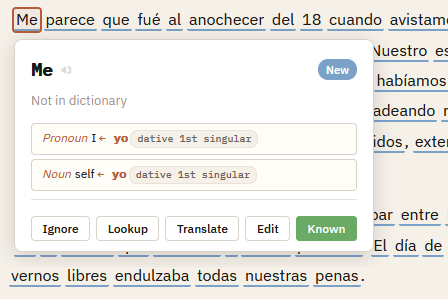
I click the first word outside the title and what do I see?
-
Okay. Dative. I could at this point research what that means or… just keep moving.
-
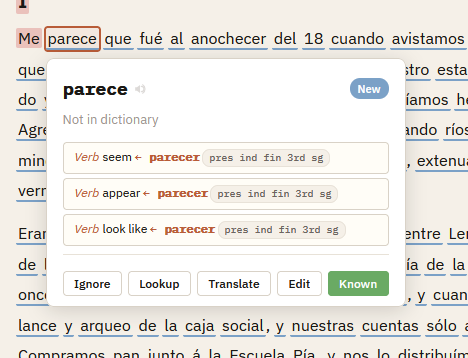
None of this is Laesi's own knowledge. The definitions come from Google Translate and Wiktionary, the grammar note comes from spaCy, and Laesi puts them in one popup and remembers what I picked.
Choosing just the first definition the app gives me for each word, I have the following:
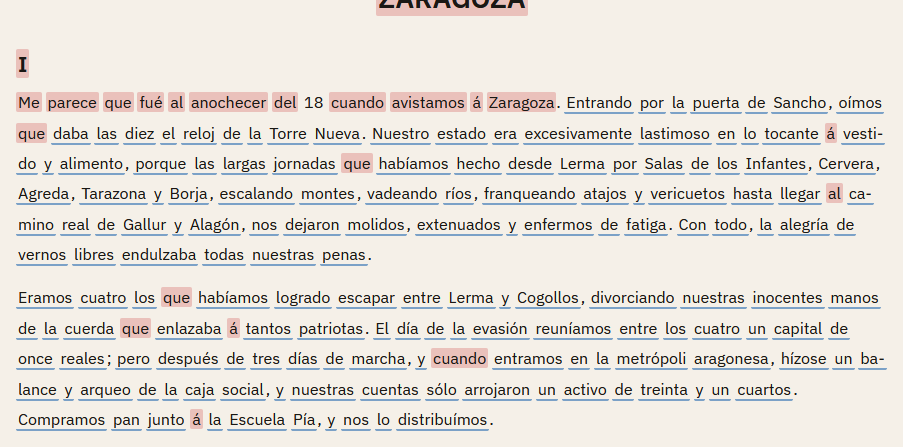
[I] [seem] [what] [was] [to the] [dusk] [of the] [18(th)] [when] [sight] [to] [Zaragoza (Saragossa)].
This is a lot, but we can go slowly the first time. As I click, what I am trying to do is build the sentence in my head and see if I get any meaning. Truthfully, on the first pass, it does not make a lot of sense. I could go with a translation to try and pull more out, but I know if these words are important I will see them again, and I move further. But here you can see what is coming for me later in the text.
-
Que, á, al, cuando. I have seen those words in one sentence. Will I remember what they meant?
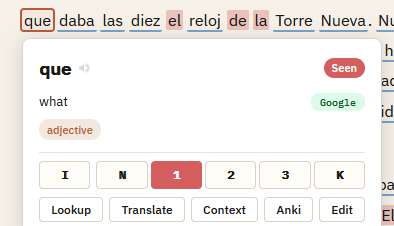
-
I saw the word again, and I recognized it, but did not remember it.
-
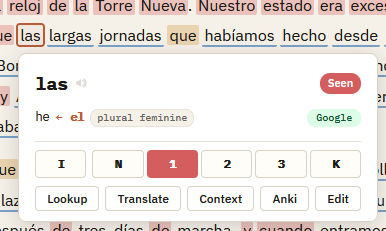
-
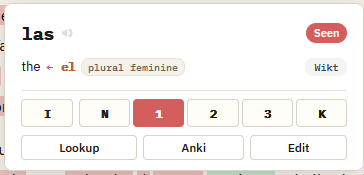
As I saw the quick definition and grammar note, I suspected the Google Translate definition was unhelpful and did a little bit of research using the Wiktionary definitions. This resulted in the following:
-
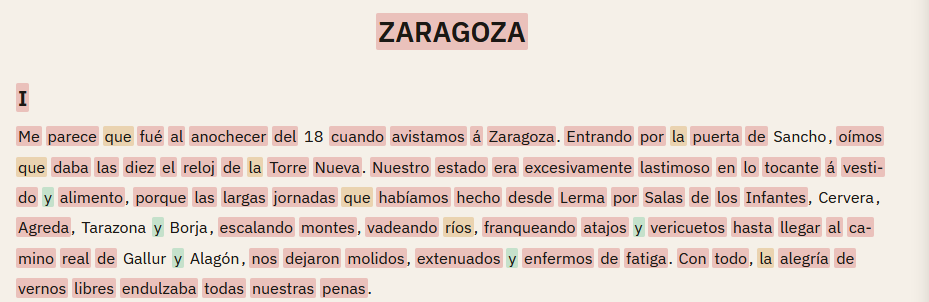
Reading the first section gives you a lot… But this is okay! A few notes. I 'ignore' anything I think is only a name, except Zaragoza, which has a different name in English.
-
Because I do not have broader context for what this text is, I am opting to use a feature now that I have struggled through the paragraph: paragraph translation.

-
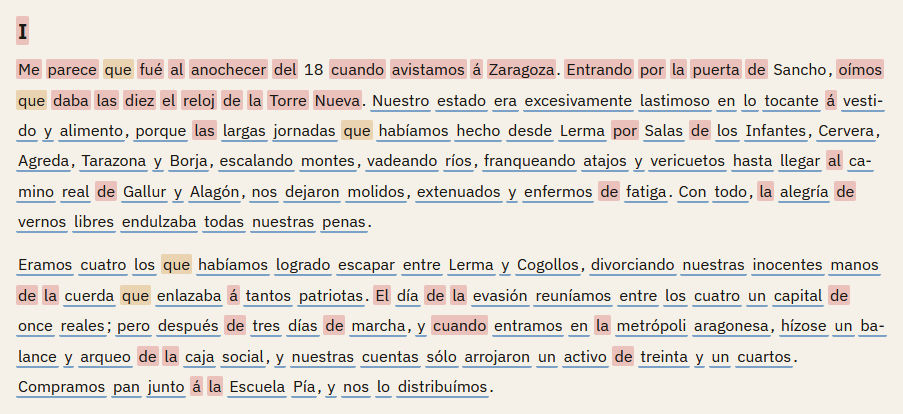
What do I have to look forward to now though? Each of these highlighted words is one I saw in the first paragraph.

-
For each one I am going to think, do I recognize this? Like a flashcard, can I remember what will appear when I click the word? If so, then I will bump up the word. Then finally, if I remember the word once or twice on sight, I will mark the word known. A word to me is known when I instantly recognize it in context. It is okay if it is premature though. I can always click the word in the future and reduce its status.
As intended, these are the 1, 2, 3 and K buttons in the popup:
- Seen. I have seen this surface form before.
- Recognized. I recognized the word, but did not remember it.
- Remembered. I remembered the saved definition with some difficulty.
- Known. I knew what the word meant in a context.
-
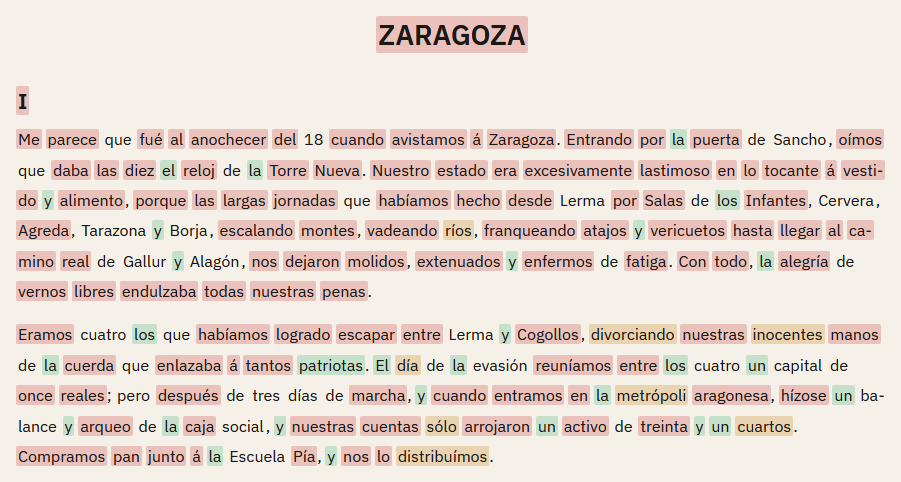
Two paragraphs in, this is where I am at. I understood nothing of what happened. However, there are words I think I already know, there are words I am already beginning to remember and recognize, and even chunks of sentences I think I can piece together. But [thing I do not understand] of three days of [do not understand, but it looks like the word march so I suspect marching]. I can then click the word, get reminded of the definition, and fill the gaps!
pero después de tres días de marcha: but [after] of three days of [marching]. This leaves me with a quick question on the de tres, but I will table any questions of 'why' for a future me to sort out.
El día de la evasión: the day of the escape, I think.
As I read, I am also noticing how much of this is words that look like a word in English and have a similar meaning, and how many words I actually do know just by having been exposed to them, like día.
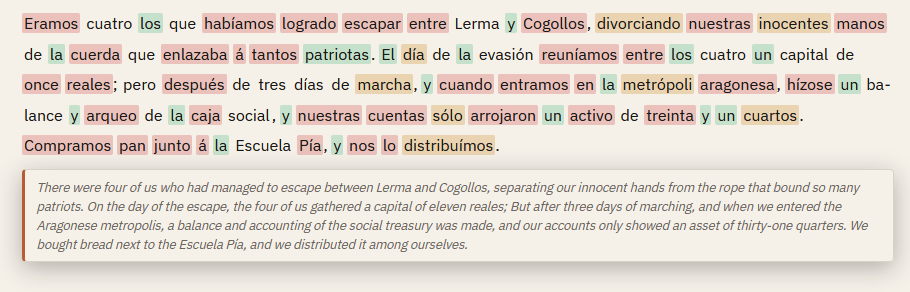
Let us use paragraph translation to test my theory:
-
"On the day of the escape." "But after three days of marching." Cool!
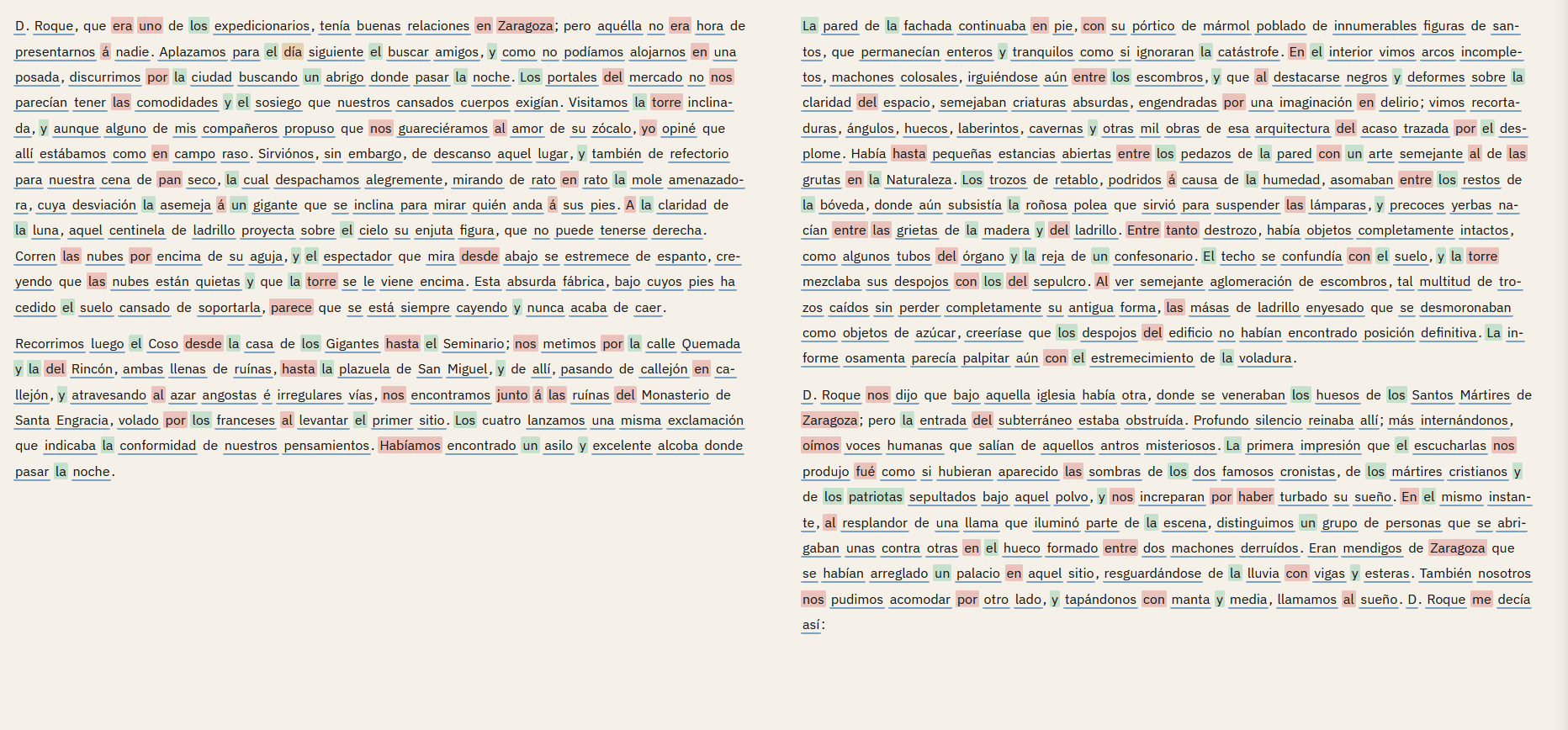
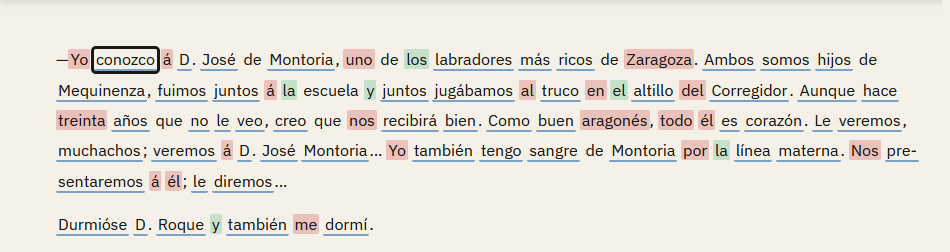
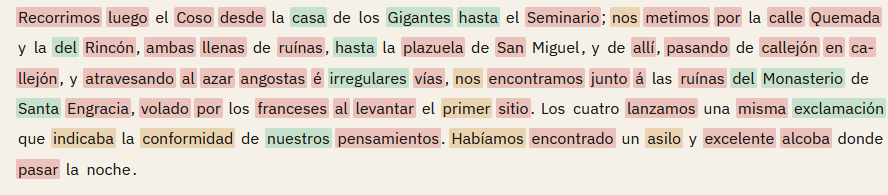
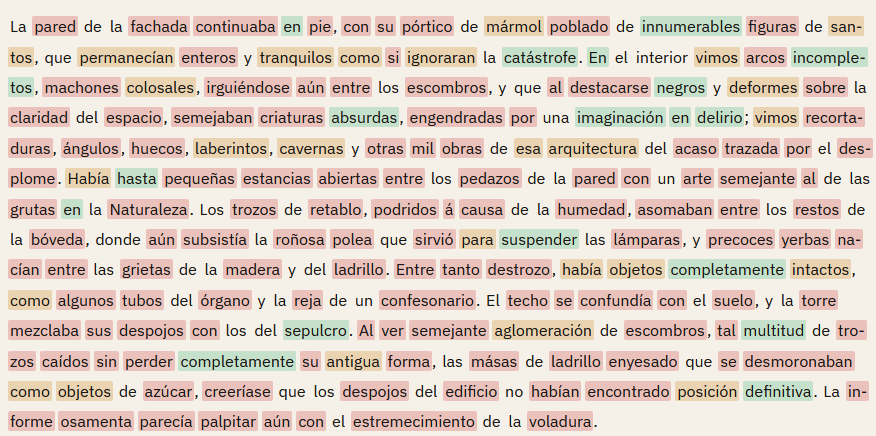
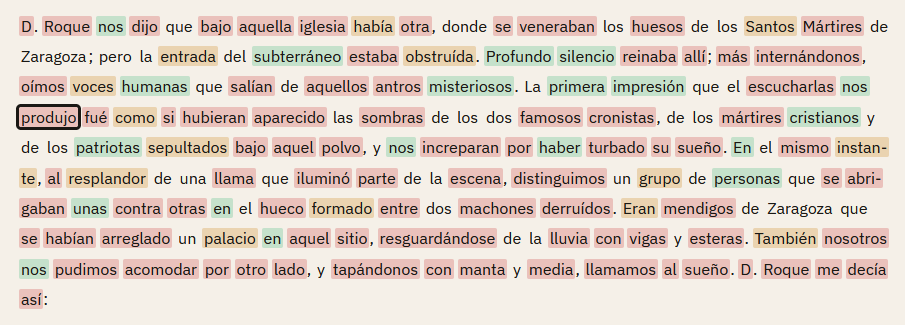
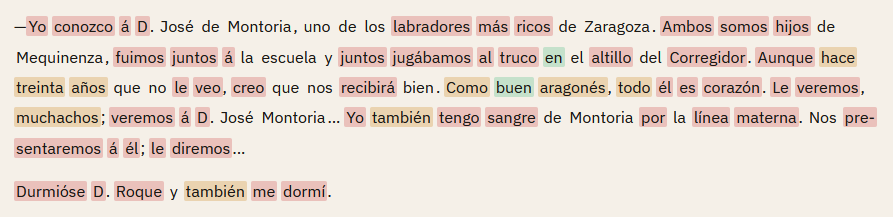
So what does the rest of the chapter look like?
-
-
Paragraph
-
By
-
Paragraph
-
-
-
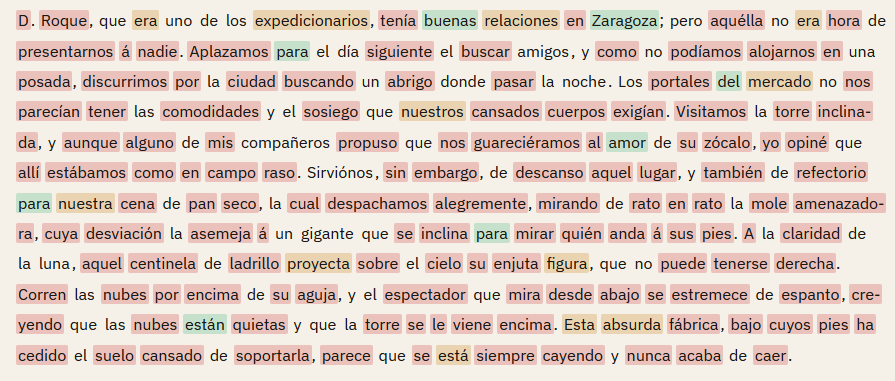
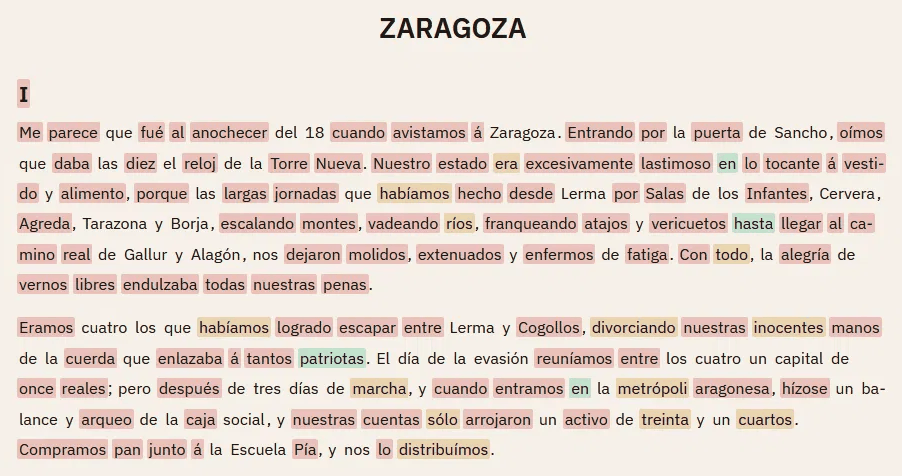
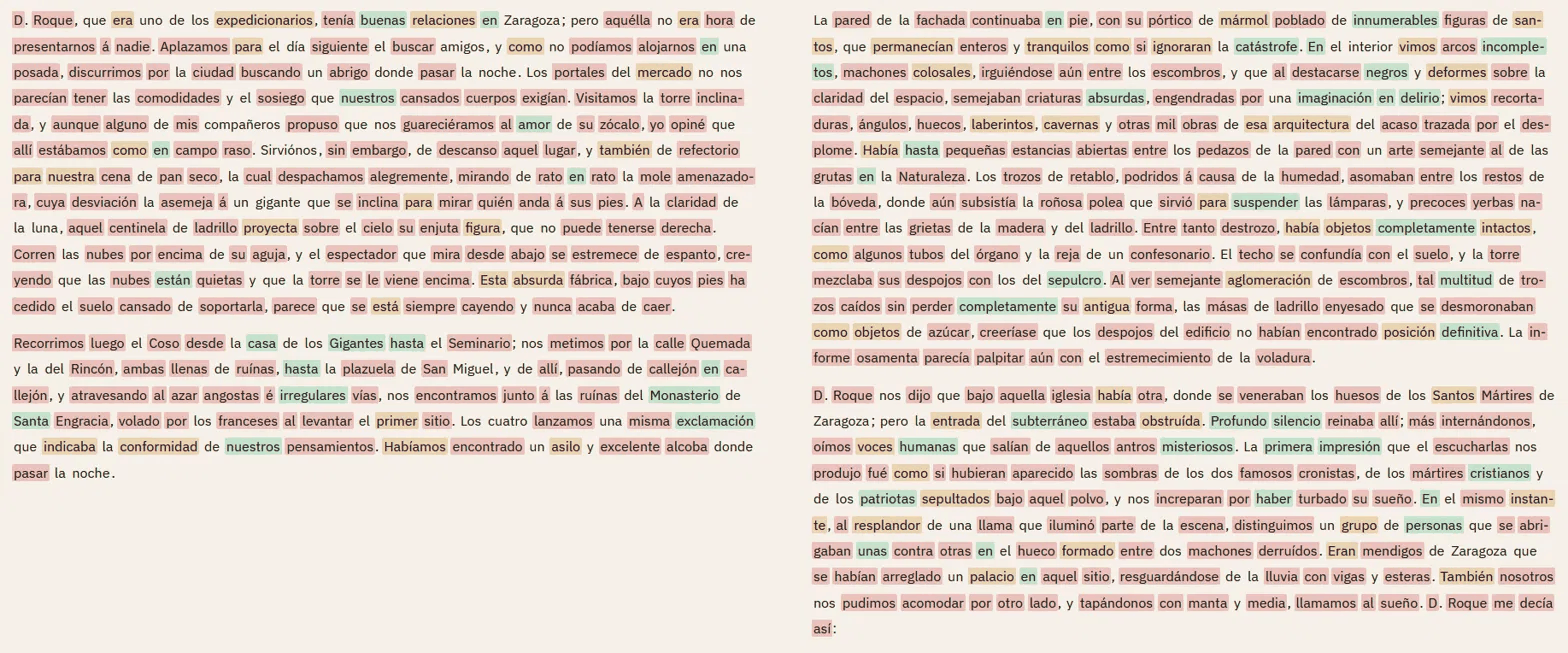
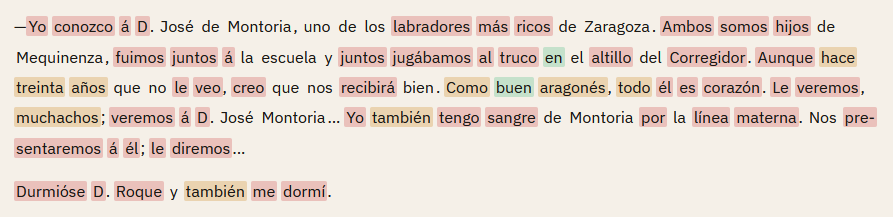
And here is the whole chapter after one pass, starting back on the first page. Red: words I saw. Yellow: words I said I recognized. Green: words I remembered. Unhighlighted are words I just ignored or reported to know.
-
-
So what was the goal? Well, this type of intensive reading is still intensive, but with a tool like Laesi, it is made more bearable. I do not need to scroll through a dictionary to find the word again. Once I have a definition, it is defined. Some will need to be revised or expanded, but mostly I can just keep reading and remaining curious.
The thing is. A single read-through of one chapter is not where this ends. I am going to read through the translations of the paragraphs. Then I am going to reread the chapter along with the audiobook, and choose words to re-assess like a flashcard. Then I am going to simply listen to the chapter of the audiobook. I will repeat this entire loop at least three times over a few days, and then start the next chapter.
What does that look like? Well, I will show you.
Later in this series I will also show what this looks like in a harder language, one without a lot of freebies. It is still possible. The workflow needs to change.
If you want to read Zaragoza along with me, it is in the Laesi Library with every word defined, the EPUB is on Project Gutenberg, and LibriVox has a free recording of it in Spanish.
Come read with us
If you learn languages by reading native content, or want to start, there is a Laesi Discord community for exactly that. No purchase necessary. Come tell us what you are reading.
Read what you actually want to read.
Laesi is a one-time purchase for Mac, Windows, and Linux: all 60+ languages, free updates for life.