You Are Probably Wrong About Anki
A primer on Anki, the flashcard app that shows each card just before you would forget it, written to clear up the misconceptions that keep people away.
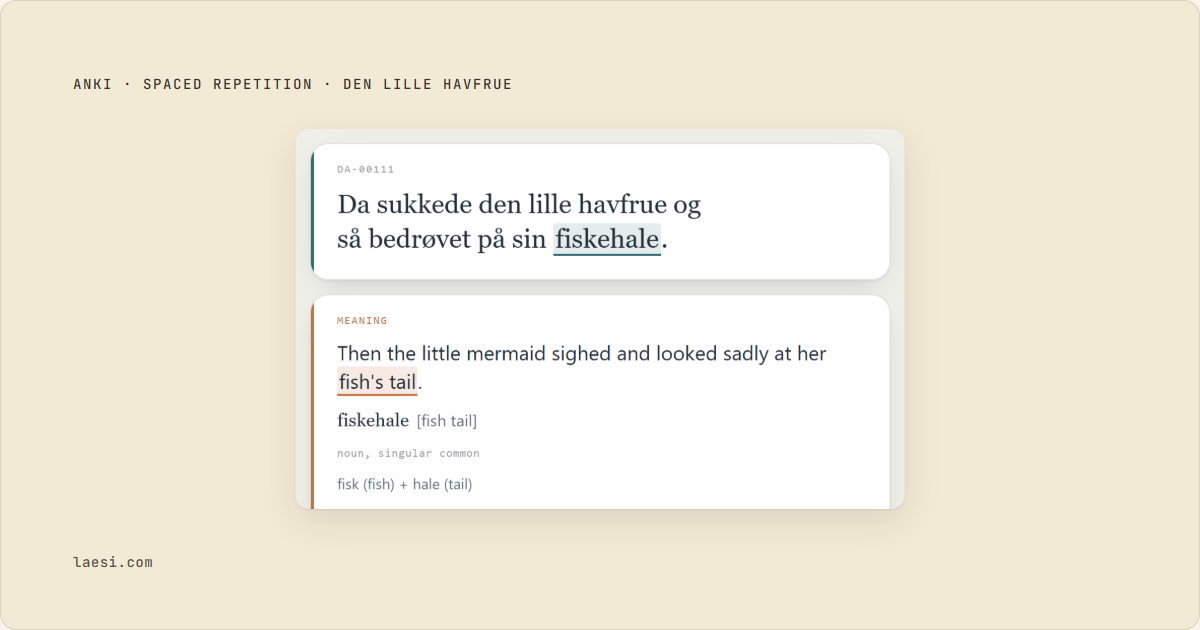
Anki is the best. I would love to tell you one day that Laesi is the best, but at least for now Anki is the best. Anki is also free (except on iOS, where it is the best $25 donation you can make). Anki does not need me to promote it either, but here we are.
If you are not using Anki at some point in your language learning journey, I would guess you are either using an alternative like Clozemaster or Memrise, have not heard of it, or have a misconception about it. This article is focused on the latter two, but may accidentally persuade the first.
What is Anki?
Put simply, Anki is a flashcard app with fine-tunable spaced repetition, or SRS. Anki is incredibly lightweight but also incredibly customizable. It features free accounts that can be used to sync your Anki 'decks' between devices. Anki has decks and sub-decks, which are like stacks of cards with a front and a back. Your goal is simply to remember what is on the back of the card when shown the front. Cards are presented from 'notes', which are like a collection of information that then gets written onto the card. A single note may have one or many cards, but the cards are what you specifically study.
The default presentation is the thing that tends to turn people off of Anki, but that is fixable with add-ons others have made, or even just by borrowing elements from an Anki deck you already like!
I made three styles for the same deck. Each one is the whole of Den lille Havfrue: 1,573 notes, one for every word form in the story, each with a sentence it appears in.
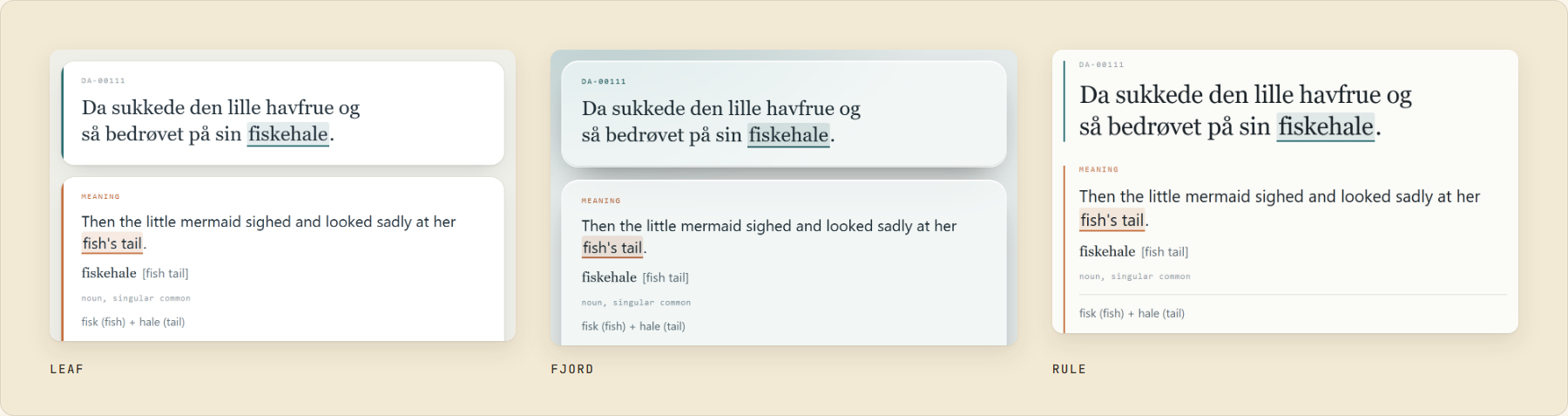
Leaf puts each side of the card on a soft panel. Download the deck (245 KB) · Styling
Fjord is frosted glass, and the heaviest of the three to draw. Download the deck (245 KB) · Styling
Rule drops the card for a single line and a clear type scale. Download the deck (243 KB) · Styling
All three share the same card templates. The decks are shared under CC BY-SA 4.0. Text from andersenstories.com. Wiktionary and spaCy model under CC BY-SA 4.0.
Each word in the decks has three cards: Recognition, Recall and Cloze. Recall is the card the deck calls Production, with the English on the front and the Danish to produce. Anki shows every Recognition card before the first Recall or Cloze card, which is how I would start. If you would rather mix them from day one, open the deck's options and, under Display Order, set New card gather order to Random cards; the words then come in random order too. To leave a card type out, search for it in the Browser (card:2 is Recall, card:3 is Cloze), select all, and suspend them.
What is SRS?
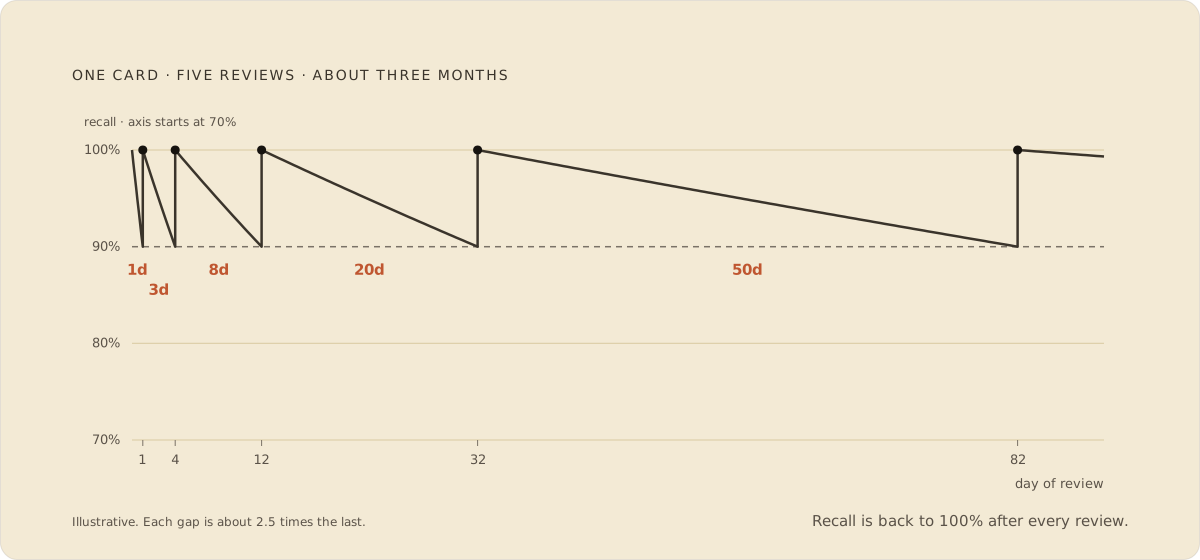
SRS, or spaced repetition system, is a system designed to help you remember things by showing them to you when you are at the cusp of forgetting them. The spacing effect behind it is well established; one review pooled 317 experiments from 184 articles. A good SRS works by essentially working with your brain to say, this is important, it keeps coming up, we should commit this to long-term memory. The process is essentially this: each day you will be shown a set of cards within your set limits, mixing ones that are due or overdue with new cards. Anki works out which cards are due, and then when you say you 'know' a card, it pushes it out to a future day, just before you are likely to forget it.
If you forget, that is okay! It will be reintroduced in a 'learning' state, and you go through the process again. The usual target is around 90% retention for 'mature' cards, and FSRS, the newer scheduler in Anki's deck options, aims for that by default. As will become a mantra on this blog over time, there is no magic save button in our brains that controls when we learn something. All we can control is whether we created the environment to help us learn or remember. Forgetting things is a normal and expected part of the process. If it is important, it will come back.
Why do I need SRS?
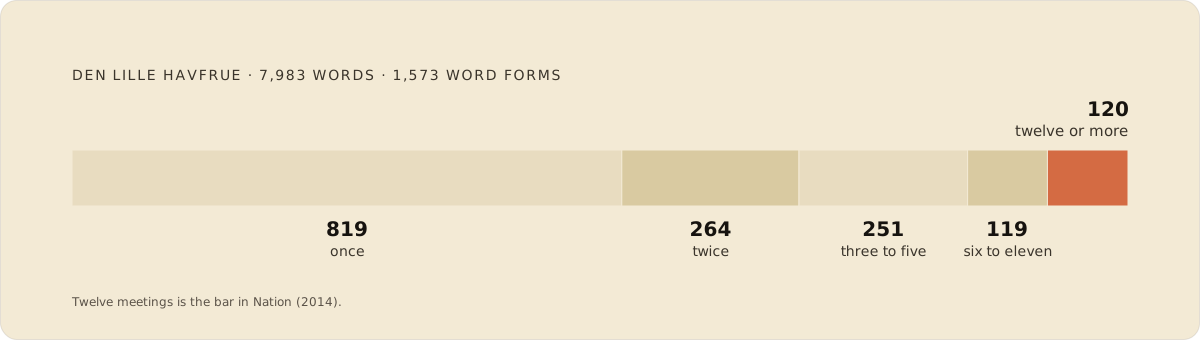
You almost certainly would benefit from Anki or another SRS app regardless of where you are in your journey. The main reason is efficiency for acquiring vocabulary and uncommon chunks and structures within the language. As I wrote in the Ultrareading post, Paul Nation counted roughly three million words of input before the words in the ninth thousand frequency band come around often enough to acquire. However, the frequency starts to drop off considerably once you leave words you might see on every page of a novel. In Den lille Havfrue, the ten most common word forms make up over a fifth of the story, while 819 of its 1,573 word forms appear exactly once. SRS is a shortcut to what otherwise might be a process of reading tens of millions of words to acquire relevant vocabulary.
Despite being a teacher of Swedish myself, I use Anki for Swedish. I have practiced things like prepositional phrases, or names of animals I saw at the zoo with my children. Given enough time and input, I could probably have figured many of these things out without Anki, but Anki makes it a deliberate part of the process to learn these things. Now, Swedish is a very similar language to English, my native language. From my own experience learning languages that share far fewer cognates with English, like Finnish or North Sámi, Anki has been extraordinarily helpful in my learning.
The other thing worth mentioning about Anki is deliberate practice. We get better at the things we do, especially when we do them with intention. A personally crafted Anki deck, with words you encountered and decided were important, is you signaling to yourself that this is something you want to practice. Doing it each day is the proof to yourself. Nation would give deliberate study like this about a quarter of your learning time. It is one of his four strands, alongside input, output and fluency practice. My own rule of thumb is closer to that of diet and exercise. I tell people language learning is at least 80% comprehensible input. If I had to give something up, I would give up Anki and focus on input, but like exercise, deep down we know better.
How should I be using Anki or SRS?
To get started, download a deck from Laesi, or find one that seems relevant on AnkiWeb, import it into Anki, leave all the default settings and just… try it. For ninety days. The one exception is FSRS, the Free Spaced Repetition Scheduler: turn it on in the deck options. Beyond that, the only lever I would encourage pulling is the number of cards you give yourself. Your daily review limit should typically be 10 to 20 times your new card limit; the Anki manual's own example is 20 new cards a day turning into about 200 reviews. Take the number of new cards you think you can do each day and cut it in half, at least. I would recommend giving yourself 5 new cards and 50 to 100 reviews a day to begin with. While you are reading, or listening, find words you think are important, look them up, and add them to your Anki deck.
Your starting card can be as simple as:
Word
____
Translation
Then, as you evolve, you may add a context sentence:
Context sentence
Word
____
Translation
Then you may try things like clozes:
Den snabba bruna [fox] hoppar över den lata hunden.
____
räven
Or you may even try full active recall:
Translation
____
Target language
The key to keep in mind is that each card should only present one new thing. Piotr Wozniak, who wrote the original SuperMemo, called this the minimum information principle. If that is a word, it is a word. If it is some bit of grammar you want to study or practice, it is that bit of grammar. Trying to take on more will drop you considerably below that 90% mark for remembering each card. If you are comfortable with that, however, there is nothing stopping you.
As I wrote this, I realized there are several more things I could say about Anki and SRS. What I think I will do is save them for another time: how to use an LLM to create a personalized Anki deck, for example, or how to combine Laesi and Anki. That all said, below is a sample you can try for yourself, built from the same decks you can download above. Like I said, Anki is the best.
The interactive sample needs JavaScript. The decks above work without it.
Langt ude i havet er vandet så blåt, som bladene på den dejligste kornblomst og så klart, som det reneste glas, men det er meget dybt, dybere end noget ankertov når, mange kirketårne måtte stilles oven på hinanden, for at række fra bunden op over vandet. Dernede bor havfolkene.
Nu må man slet ikke tro, at der kun er den nøgne hvide sandbund; nej, der vokser de forunderligste træer og planter, som er så smidige i stilk og blade, at de ved den mindste bevægelse af vandet rører sig, ligesom om de var levende. Alle fiskene, små og store, smutter imellem grenene, ligesom heroppe fuglene i luften. På det allerdybeste sted ligger havkongens slot, murene er af koraller og de lange spidse vinduer af det allerklareste rav, men taget er muslingeskaller, der åbner og lukker sig, eftersom vandet går; det ser dejligt ud; thi i hver ligger strålende perler, én eneste ville være stor stads i en dronnings krone.
Havkongen dernede havde i mange år været enkemand, men hans gamle moder holdt hus for ham, hun var en klog kone, men stolt af sin adel, derfor gik hun med tolv østers på halen, de andre fornemme måtte kun bære seks. Ellers fortjente hun megen ros, især fordi hun holdt så meget af de små havprinsesser, hendes sønnedøtre. De var 6 dejlige børn, men den yngste var den smukkeste af dem alle sammen, hendes hud var så klar og skær som et rosenblad, hendes øjne så blå, som den dybeste sø, men ligesom alle de andre havde hun ingen fødder, kroppen endte i en fiskehale.
Hele den lange dag kunne de lege nede i slottet, i de store sale, hvor levende blomster voksede ud af væggene. De store ravvinduer blev lukket op, og så svømmede fiskene ind til dem, ligesom hos os svalerne flyver ind, når vi lukker op, men fiskene svømmede lige hen til de små prinsesser, spiste af deres hånd og lod sig klappe.
Come read with us
If you learn languages by reading native content, or want to start, there is a Laesi Discord community for exactly that. No purchase necessary. Come tell us what you are reading.
Read what you actually want to read.
Laesi is a one-time purchase for Mac, Windows, and Linux: all 60+ languages, free updates for life.